

How Leaders Build Trust in an Insular World
Trust has become the designer handbag of leadership: everyone wants it, very few people know how to spot the real thing, and there are a lot of impressive-looking fakes.
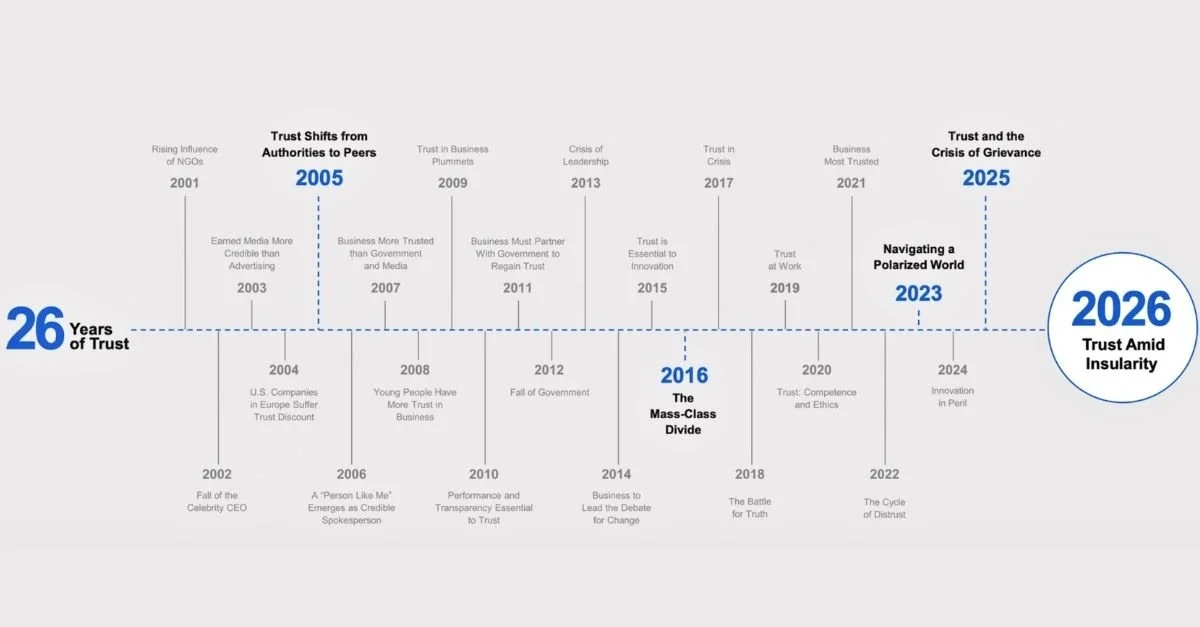
The 2026 Edelman Trust Barometer has labelled this moment ‘Trust Amid Insularity’. Not exactly a phrase you’d put on a tea towel, but an important one. Edelman describes a world retreating into smaller circles of trust, shaped by the pandemic, misinformation, discrimination, geopolitical tension, cost of living pressure and economic displacement. It also found that seven in ten people globally are hesitant or unwilling to trust someone who is different from them.
So, first question: what does insularity actually mean?
In plain English, it means closing in. It is the state of becoming isolated, detached, narrow and suspicious of ideas, cultures, people or perspectives outside your own immediate group.
In even plainer English: “I trust people like me. The rest of you can wait outside.”
We see this everywhere in politics. The promise of certainty, belonging and “our people first” is booming like a sausage sizzle outside Bunnings. In Australia, One Nation’s polling surge has generated serious commentary about the seats where it could become a major force. Across the US, UK and Europe, similar patterns are obvious: leaders and movements that offer simplicity, certainty and identity are finding eager audiences and you can read more about this in my article Is it time to take Pauline Seriously in the Financial Review.
But my fascination here is not really with them.
It is with you — the leader in your own field.
Because, if the world is becoming more insular, your job is not simply to have better facts. Facts matter, of course. But in a mistrustful room, facts can be like serving broccoli to a toddler: noble, green and largely ignored.
Last year, I contributed to The Age of Doubt: Building Trust in a World of Misinformation, edited by ABC journalists Tracey Kirkland and Gavin Fang. The book explores why trust is disappearing and how leaders, institutions and communities might begin to rebuild it. There are many excellent ideas in that conversation, but my article on Gravitas is an isolated cell of looking at what we present in ourselves.
You may say, I have a certain hammer, so everything looks like a nail, but the results speak for themselves. Gravitas is quite literally the manner of trust and respect. And here is the uncomfortable bit: many leaders are still trying to build trust without it.
They prepare the slide deck. They gather the data. They polish the facts until they sparkle. Then they walk into the room with a tight jaw, a rushed voice, vague gestures and the physical presence of someone hoping the fire alarm goes off before question time.
No wonder trust limps out the side door.
The ancient rhetoricians understood this long before we invented Teams meetings, leadership offsites and the phrase “just circling back”. They taught that communication had five canons: invention, arrangement, style, memory and delivery. And for leaders then and today, delivery is where the trust gap often lives.
That means the body.
The voice.
The breath.
The gestures.
The eyes.
The capacity to stand in difference without shrinking, snapping or sermonising.
This is not ‘faking it to make it. Edelman’s research makes this deeply practical. When responding to a highly divisive social issue, 35 per cent of people said a business could earn their trust by encouraging people to cooperate on solutions without taking a side. Twenty-eight per cent wanted the business to support the position true to its values. Only 13 per cent wanted the business to support their own position. This means having a physical presence that can remain neutral, holding the eyes and gesturing to people without negating your intention by pulling the arms back in.
The trusted leader is the one who can hold the centre. They can listen without collapsing, disagree without attacking, and create enough safety for people to think beyond their own little bunker.
Where was that taught at university?
It certainly wasn’t in “Accounting 101”, “Advanced Spreadsheet Survival” or “How to Sound Intelligent While Secretly Panicking”.
Yet this is now core leadership.
It is Gravitas.
So, what do you do?
You stop treating trust as a slogan and start treating it as a skill.
You make the room feel that, even if people disagree, they will not be humiliated, dismissed or spiritually flattened by a PowerPoint clicker.
In an insular world, trust is not built by shouting, “Trust me!”
Trust is built in repeated human moments: the way you enter, the way you listen, the way you respond under pressure, and the way you help people move from “me and mine” to “us and what now?”
If insularity is a retreat, Gravitas is the bridge.
And heaven knows, we need more bridges.
Love,
Dr Louise Mahler