

The anatomy of a political spark and what every leader can learn from it
What is it about Jon Ossoff?
Following the American midterm elections last week, the 39-year-old senator from Georgia has suddenly found himself in the conversation about the next US presidential election.
He has been described as having the same ‘spark’ as Barack Obama.
Now THAT is interesting.
Because for those of us fascinated by leadership, influence and the extraordinary ability of some people to command a room, the obvious question is:
Can we identify that spark? Can we learn it? Or is it simply, as the immortal Dennis Denuto declared in The Castle, "the vibe"?
Let's investigate.
First, the obvious.
He's tall. Good-looking. Young.
He has fabulous teeth, dimples and the sort of hair that could probably win an election on its own.
All very well.
We know that physical attractiveness can influence our initial perceptions of people, particularly in leadership. But it is a mighty shallow explanation for the excitement surrounding this man.
So let's look deeper.
Is it what he says?
Ossoff is a disciplined speaker.
He uses the familiar rhetorical pattern of three, builds longer lists of 5, creates momentum through repetition and understands how to structure an argument towards a powerful conclusion.
These are valuable skills. But they are hardly revolutionary.
Politicians have been using them since Cicero was entertaining the Romans, and modern Democrats certainly haven't been shy about borrowing a few tricks from Obama.
There is, however, one small linguistic moment worth noting.
As Ossoff walks on stage following his re-election victory, he opens with:
"Georgia, you did it."
Not "I won".
Not "We smashed them".
But "Georgia, you did it".
Three simple words that place the audience, rather than the speaker, at the centre of the achievement.
Take note.
It's a beautiful example of how leadership language can transfer ownership, create connection and make people feel part of something larger than themselves.
But even that is not the whole story.
Now watch the body.
This is where things become particularly interesting.
As Ossoff takes the stage, there is a wry smile on his face.
He appears to be enjoying himself.
Not performing enjoyment. Not desperately trying to look relaxed. There is an ease in the way he approaches the microphone, as though he genuinely loves playing the game.
And this matters.
Because so many leaders walk onto a stage already fighting themselves.
Their jaws are clenched. Their shoulders are elevated. Their necks are rigid. Their breath has retreated somewhere into the upper chest, where it is desperately trying to survive.
Then they wonder why they don't sound authoritative.
Ossoff presents a striking contrast.
His jaw appears loose. His face is relatively free of visible tension. His posture is upright and his voice is clear, resonant and powerful.
At moments, he launches into a great vocal cry, reminiscent of Robin Williams announcing "Good Morning, Vietnam!"
It is expansive. Unblocked. Gloriously alive.
And when the crowd erupts, he can drive a statement through the noise without appearing to sacrifice his breath or vocal flow.
That is no small skill.
His power appears to be grounded in his lower body, rather than trapped around his throat and shoulders.
He also understands the psychology of space. He doesn't merely arrive at the microphone. He makes an entrance.
There is an important distinction.
Many leaders try to manufacture authority by adding more effort. Ossoff demonstrates what authority can look like when unnecessary effort is removed.
But there is one feature of his delivery that particularly interests me.
And you may not have noticed it.
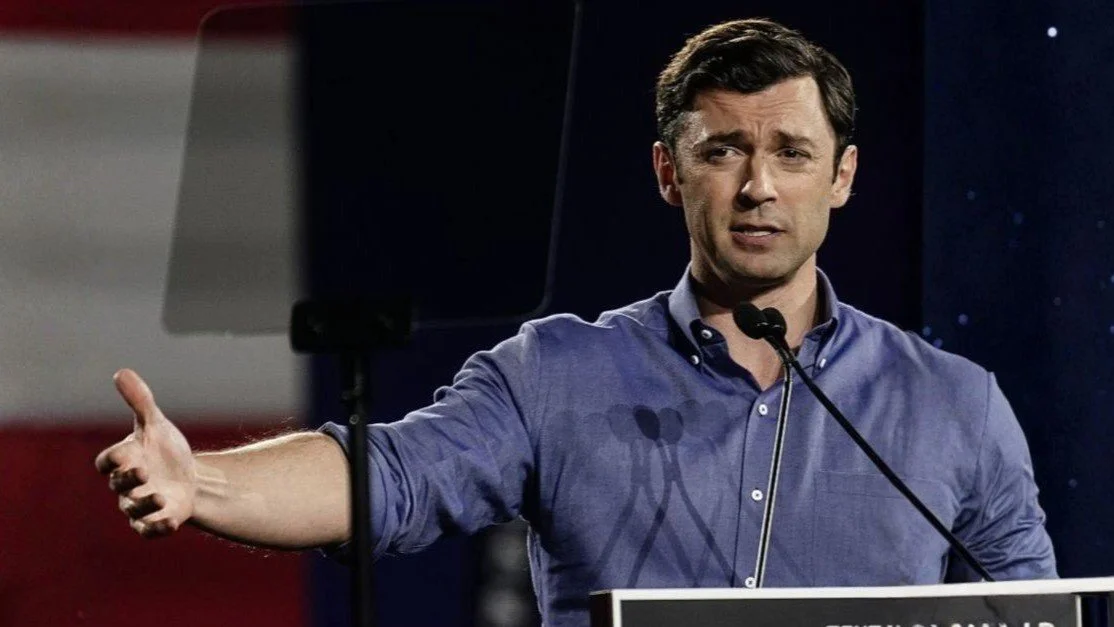
Watch his right arm.
Throughout the speech, Ossoff makes extensive use of his right arm.
His left arm plays a more restrained role.
Importantly, he rarely closes himself off by bringing his arms across his body.
Instead, the right arm repeatedly extends outwards, sometimes remaining there as he continues speaking. It is an extraordinary visual statement. Why?
Because gesture is not simply decoration added to words. It contributes to the psychological meaning of the message.
An arm extended into space can create a sense of openness, direction, invitation and possibility.
In some symbolic traditions, the right side is associated with action, the future and positive movement. These associations are neither universal nor a scientific rule, but they offer an interesting lens through which to consider his delivery.
What interests me more is the physical effect.
Ossoff does not continually retreat into himself.
He reaches out.
He occupies space.
And, importantly, he is comfortable leaving his arm extended rather than immediately withdrawing it.
That takes a certain physical confidence.
Many executives I work with have been taught to gesture, but they have not been taught to hold a gesture.
Their hands dart out and immediately return to safety. Their arms cross the body, their hands clasp together or their movements become repetitive little flicks around the waist.
The result can be an impression of hesitation rather than conviction.
Ossoff's gestures create a different impression.
He is not simply illustrating his words.
He is giving those words somewhere to go.
So what can we learn?
Get that right arm out!
Yes, I am serious. Not at every opportunity. Not in every conversation. And certainly not while negotiating your way through a crowded restaurant carrying three glasses of wine.
But develop the physical capacity to extend an arm openly, occupy the space beside you and remain comfortable there.
Practise making a statement while your arm remains extended.
Feel the grounding through your legs.
Allow the breath to flow.
And resist the temptation to immediately withdraw your gesture as though you have accidentally touched an electric fence.
This is not about copying a politician's mannerisms.
It is about developing a repertoire of physical choices that allow you to communicate with greater authority.
Because gravitas is not just about what you say. It is about how comfortably you inhabit the space from which you say it.
And when the body, breath, voice and message work together, something rather wonderful can happen.
People stop noticing the technique.
They simply experience the presence.
Or, as Dennis Denuto might say, the vibe.
And there's an Australian twist.
We Australians can claim a little piece of Jon Ossoff.
His grandmother came from Brisbane, his grandfather from Footscray, and his Australian-born mother, Heather, grew up in Sydney.
He even grew up eating Vegemite.
Now, I would love to argue that this extraordinary leadership presence is the product of good Australian breeding, but I suspect that might be stretching the evidence just a touch.
Nevertheless, we can certainly learn from him.
Whatever your political persuasion, his delivery offers a fascinating study in the relationship between physical freedom, vocal authority and the perception of leadership.
The lesson is not to become Jon Ossoff.
It is to recognise that the mysterious quality we call presence is not entirely mysterious at all.
There are skills behind it.
And skills can be learned.
Perhaps the spark isn't something you are born with. Perhaps it is something you learn to stop blocking.
Love,
Dr Louise Mahler