

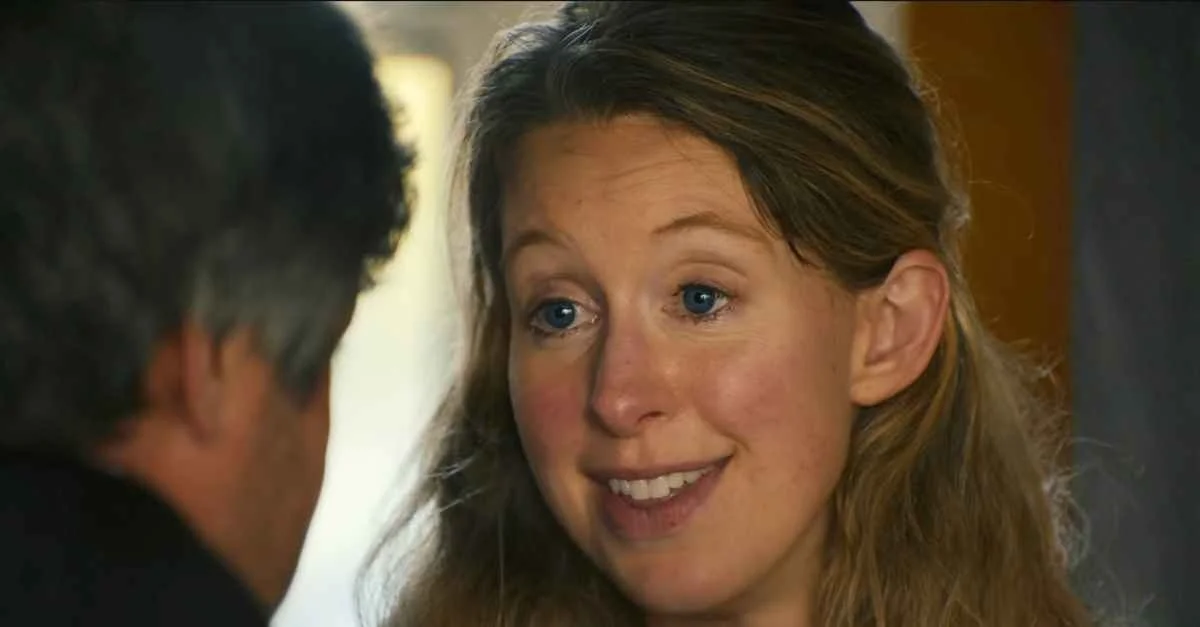
What Elizabeth Holmes can teach us about trust, deception and the extraordinary things our bodies do under pressure.
I don’t work with liars.
I work with people who tell the truth.
The problem is that sometimes people who tell the truth look remarkably like liars.
And that, dear reader, is where my work becomes fascinating.
Because under stress, we change.
Our bodies change. Our voices change. Even our language changes.
And without ever intending to deceive anyone, we can produce a spectacular collection of signals that make other people doubt every word coming out of our mouths.
The tragedy is that you can be telling the absolute truth and still look as guilty as sin.
Which brings me to the extraordinary Elizabeth Holmes.
I have been watching the trailer for a documentary about the disgraced Theranos founder, and goodness me, what a feast of communication contradictions!
Now, let me be clear. I am not attempting to establish whether Ms Holmes was lying in any particular moment. Her criminal convictions are a matter of public record. What interests me is how her communication is presented to us, and why certain behaviours leave us feeling so profoundly uncomfortable.
Because the producers have clearly constructed a story.
And it is a story absolutely dripping with red flags.
So, what are we seeing?
1. The language: When an answer isn't an answer
Let's start with a classic.
The interviewer asks a direct question about whether she is telling the truth.
Her response?
"Why would I not tell the truth?"
Oops.
This is a fascinating linguistic manoeuvre.
Rather than answering the question, she challenges the premise of the question itself.
Instead of a simple "Yes", she effectively asks the interviewer to justify their suspicion.
Now, does this mean she is lying?
Absolutely not.
But it does mean she has avoided the direct answer, and that is a response we often associate with people who have something to hide. Watch any murderer under interview (yes, I waste my evenings) and you will hear this linguistic trickery over and over.
There is a lesson here for leaders.
When someone asks you a direct question, answer it.
The more you dance around the answer, the more your audience starts wondering why you're dancing.
2. The voice: Seduction, sincerity and something rather spooky
Ah, the voice.
Elizabeth Holmes became internationally famous for her unusually low vocal pitch, with considerable discussion about whether she deliberately lowered it to project authority.
She was hardly the first woman to recognise the relationship between vocal pitch and perceptions of leadership.
Margaret Thatcher famously underwent vocal training, and recordings of her public speaking reveal a considerable shift in her vocal delivery over time.
But times have changed.
Today, I am much more interested in helping leaders discover their own comfortable, resonant vocal range than encouraging them to manufacture a sound they believe the world wants to hear.
And in this footage, it is not Holmes's pitch that particularly interests me.
It is her breathiness.
When the vocal folds do not close completely during phonation, air escapes alongside the sound, creating what we recognise as a breathy voice.
Breathiness can communicate different things depending on the circumstances.
It can be associated with intimacy and sexual attraction.
Chunking up, it can also suggest giving, warmth and caring.
In other words, it can be a useful tool in creating a sense of connection.
But, as the saying goes, it ain't what you do, it's the way that you do it.
And in this particular context, the combination of that soft, breathy delivery with emphatic declarations of credibility is spooky.
3. The eyes: The windows to the soul?
Now we come to the part that really catches everyone’s attention.
The eyes.
Holmes appears remarkably reluctant to blink.
There is research exploring relationships between blinking, attention, arousal and particular psychological characteristics. While, blink rate is not a reliable test of deception or psychopathy, it can be very concerning.
What interests me is not a diagnosis.
It is the impression.
Because when somebody maintains an unusually prolonged, intense gaze, we can experience that gaze as threatening, confrontational or simply uncomfortable.
And Holmes takes this to another level.
At moments, her eyes appear extraordinarily wide, with white visible above and below the iris.
This appearance, sometimes called scleral show, can contribute to an impression of heightened intensity.
Of course, eye shape, facial anatomy and individual habits all play a part. We cannot confidently read someone's emotional state from eye opening alone.
But perception is a different matter.
And when we combine the wide eyes with the prolonged gaze and minimal blinking, the overall impression can be decidedly unsettling.
Then she smiles.
Oh dear.
4. The smile: When the pieces don't fit
Here is something I find endlessly fascinating about human communication.
We don't interpret individual body movements in isolation.
We read the whole performance.
The eyes. The face. The voice. The words. The rhythm. The physical movement.
And we are particularly sensitive to moments when these elements appear to contradict each other.
A smile is ordinarily a powerful signal of warmth and welcome.
But what happens when a smile is accompanied by an intense, unrelenting stare and a strangely disconnected facial expression?
We struggle to reconcile the signals.
Is this warmth?
Is it reassurance?
Is it control?
Our brains are looking for a coherent story, and the story isn't coming together.
It is this lack of apparent congruence that makes the footage so compelling.
And we haven't even reached the neck!
5. The head: A peculiar contradiction
In several moments, Holmes displays shaking head movements.
Now, I am particularly interested in the relationship between the head, neck, breath and voice because physical tension can dramatically affect how we communicate.
A rigid or poorly coordinated neck can interfere with freedom of movement, breathing patterns and vocal production.
And here we have an interesting combination.
On the one hand, the breathy voice and smile can suggest gentleness and connection.
On the other, the pronounced head movements create an impression of tension, intensity and agitation.
It is a curious recipe.
Individually, these behaviours may mean very little.
Together, they create an impression that is difficult to reconcile.
And that matters.
Because trust is not simply about what we say. It is also about whether all the elements of our communication appear to belong to the same person, in the same moment, telling the same story.
6. Personal space: Now this is getting interesting
Finally, the camera draws back.
And we see something quite extraordinary.
The interviewer and Holmes are positioned remarkably close to one another.
There is a degree of spatial intimacy that would make many people uncomfortable, particularly in such a confrontational exchange.
Most of us respond to someone entering our personal space by making small adjustments.
We lean away.
We turn slightly.
We reposition our bodies.
We attempt to restore a comfortable distance.
Yet Holmes appears quite willing to maintain this proximity.
No obvious retreat.
No significant withdrawal.
She simply continues.
Again, we cannot know what she is experiencing internally. Camera placement, editing and the circumstances of the interview all matter.
But visually, the effect is extraordinary.
The interviewer is almost inside her personal space, and Holmes appears undisturbed.
It adds yet another layer to an already disconcerting performance.
So, is this what a liar looks like?
Here comes the twist.
No.
And that is precisely why this matters.
The documentary producers have selected and assembled footage that encourages us to interpret Holmes through a particular lens.
Knowing what we know about her history, it is very easy to watch the trailer and declare that the warning signs were there all along.
Perhaps some were.
But many of the individual behaviours we have examined can also appear in people who are anxious, frightened, exhausted, socially uncomfortable or under extraordinary pressure.
And this is the challenge I face every day in my work with senior leaders.
They may be completely honest.
They may be exceptionally competent.
They may be thoroughly committed to doing the right thing.
But under pressure, their voices tighten, their breathing changes, their movements become awkward and their language suddenly resembles a witness being cross-examined.
They look less credible precisely when they most need to be believed.
That is the Gravitas Gap.
The gap between who you are, what you intend and what other people experience in your presence.
And it can be devastating.
So, the real lesson from this fascinating piece of footage is not that we can identify a liar by counting blinks, studying smiles or measuring the distance between two chairs.
We can't.
The lesson is that human beings are extraordinarily sensitive to the overall coherence of communication.
And when the words, voice and body appear to be telling different stories, trust can begin to unravel.
You don't have to be a liar to look like one.
And you don't have to be telling the truth to look completely convincing.
Now, isn't that intriguing?
Love,
Dr Louise Mahler