

How to Improve Your Speaking Voice Without Vocal Training
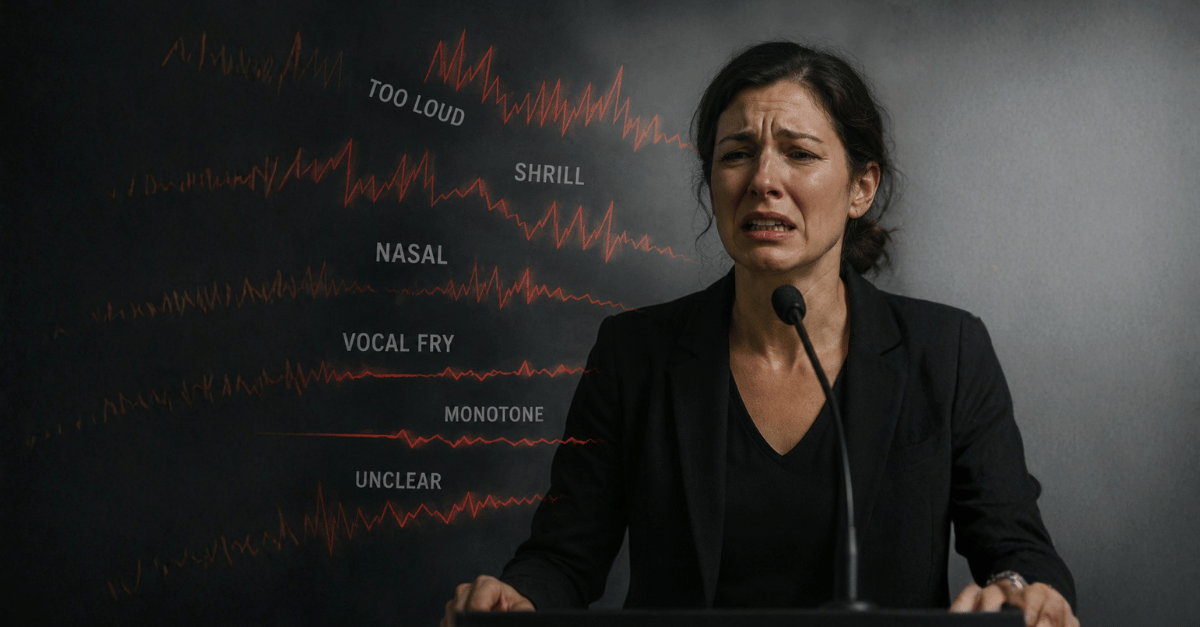
Is your voice a problem?
If you are riding the Tour de France, you need trainers, support staff, a magnificent bike, extraordinary skill and the stamina of a small herd of oxen.
If you are riding your pushbike to the shops, it's rather less complicated. You need to know how to pedal, steer and, ideally, use the brakes.
The same is true of the voice.
If you are singing the lead in a musical eight performances a week, vocal production is serious business. You need technique, stamina, recovery and a support team, as well as buckets of lubricating water and steam.
But if you are speaking occasionally in a meeting of 12 people, the level of difficulty drops exponentially. And just as the person wobbling down to the shops can't reasonably blame the bicycle, you can't keep blaming your voice.
Yet we do.
"I have a small voice."
"My voice goes funny under pressure."
"I hate my voice."
"I can't sing."
Poor voice.
It gets blamed for everything.
And it is an easy target because the voice is a strange beast. We know it exists, but we can't see it. We can't pick it up. And we can't feel what goes on in the larynx.
Best of all, it can't fight back.
So we talk about "the voice" as though it were an unfortunate piece of equipment, and we were issued a dud one at birth.
Wrong.
Your voice is a combination of physical capabilities with which you were born.
I was astounded this week to be speaking with a coaching client in their first session who told me they had a bad voice and then revealed they had no idea that speaking had everything to do with breath flow. Voice ISSSSSSS breath flow!!! I thought I was going to hyperventilate!
Breath moves. Vocal folds vibrate. Sound resonates through the body and comes out the mouth, after which it pulsates against the eardrums and skin of others. Bingo.
Which means that much of what we describe as a "bad voice" is actually a collection of physical habits of blockage.
We hold the breath.
We tighten the throat.
We collapse the body.
Then we fail to finish sentences.
We are perceived as speaking too quickly.
And we lose energy at the end of a thought.
None of these is destiny.
And this is where I think we make voice unnecessarily mysterious. You do not need to become an opera singer to speak well in a boardroom. You don't need three hours of vocal exercises before the Monday meeting. You don't need a steam machine. And you don't need incredible expertise.
You need the equivalent of learning to pedal and brake the push bike.
And this mostly means unlearning rather than learning. Remember, all babies can scream for hours and never go hoarse.
So, know how to breathe.
Know how to breathe under stress.
Know where to place the tension for power.
Know how to open your mouth.
That is vocal intelligence.
What's more, the colour of the voice will take centre stage once you get the basics. There is no need to think of what people perceive as your pitch, pace or volume. These things just happen.
The extraordinary thing is that a comparatively small amount of knowledge can create an enormous difference.
It's just not that hard.
And once you understand that, blaming the voice becomes rather like standing beside your bicycle, pointing accusingly at it and saying:
"It simply refuses to go to the shops."
Love,
Dr Louise Mahler