

Want to speak better in public? Ditch the lectern
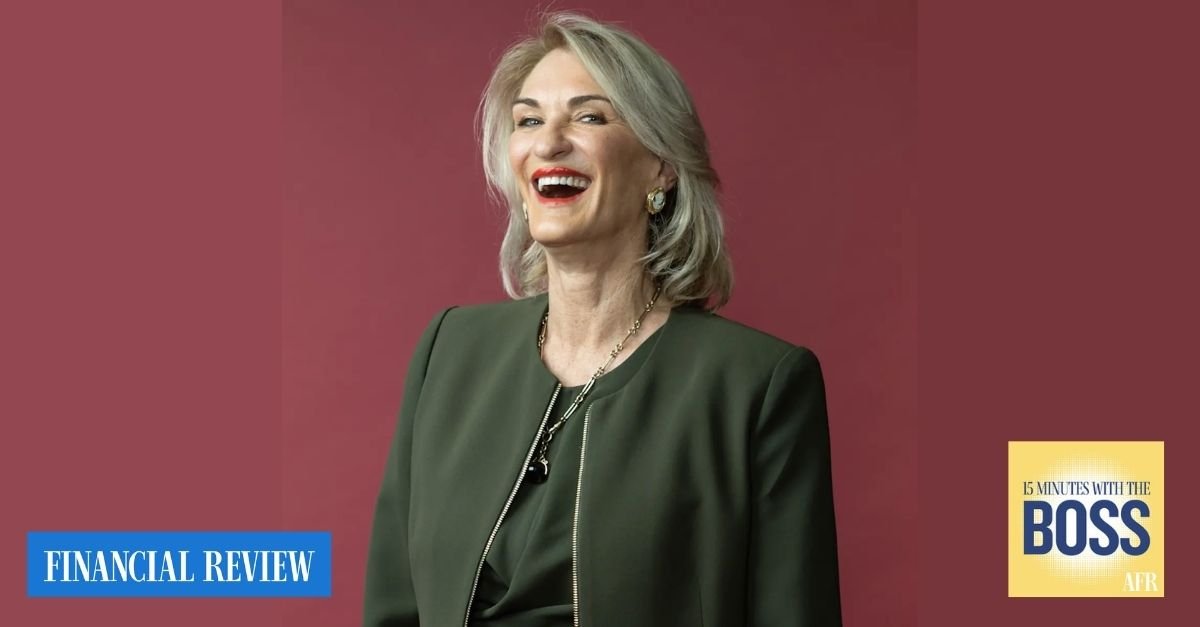
Communications expert Louise Mahler has spent years helping leaders gain confidence, presence, and influence in the way they communicate. A former opera singer, she knows a thing or two about the need to breathe and move when performing on stage.
Another tip is to introduce humour and laughter. “Laughter is a bouncing diaphragm, and that’s really the core thing that we need, for our diaphragm to be loose,” Mahler says.
“If you can get people to laugh, the diaphragm loosens up, becomes flexible again, and we can all breathe, and we can all speak, and get the voice out.”
Here is an edited transcript of host Sally Patten’s conversation with Mahler.
Sally Patten: What do you do in the morning?
Louise Mahler: I get up about 6am. I have a trainer because if the trainer wasn’t standing there I wouldn’t turn up. If I did turn up, I wouldn’t do the exercises, so I have someone who beats me into submission twice a week, and then I try to go myself another time.
Do you eat breakfast?
No, I hate breakfast. I could throw up at the thought of breakfast. I have brunch and dinner.
And what about coffee? Are you a coffee drinker?
Coffee, definitely. After the gym, it’s straight to the coffee. That’s my reward.
Was there something that happened in your career that changed the whole nature of what you were doing?
Totally. First of all, I sang opera for a decade. I was in the Vienna State Opera, and when you sign a contract there, you sign away your life. We had to do contemporary opera, and I was doing an opera where I was playing a role where I was basically in the nude, and they were trying to make me do a sexual performance with a man.
I remember freezing and thinking, “I don’t want to do this any more. I give up.” That was a pivotal moment.
And how did you use that to move on to a different career?
I had a degree in econometrics and there I was in the nude doing singing. It just didn’t work for me. It was not satisfying in any way, and I just went stop. Many people don’t say stop.
It is an issue for people who are, say, professional sportspeople, footballers, or in the army. You have to change your identity. I had to rebuild my identity. As an opera singer, people are fascinated in everything you do. When you’re no longer doing that, nobody cares, and that was really difficult.
I was good at maths, so I went into computer programming. I was part of the management team very quickly. I would watch [my colleagues] present, and they would do the weirdest things.
We had a general manager who, every time he asked questions, he would grab for his genitals, and I thought, “What is going on here?” It fascinated me. He didn’t seem to know that he had this repetitive habit every time he was put under stress.
I could see the audience switching off. I realised that these habitual patterns, which was something in opera and music we worked on every day, was something that no one had any awareness of in business, and yet were critical for the credibility of their communication.
Often it’s not what you do. It’s what you’re doing to turn people off.
One day, I went into the general manager and said, “I’ve got these ideas about bringing skills from opera into business,” and he said, “Great, Louise, tell me more about that.”
I said, “It starts with breath. I don’t think anyone’s realising how their stress is affecting their voice.”
I said, “Are we looking at the way we manage our words in a structure like a musical composition?” And he said, “Tell me more.” This went on. Finally, I finished, and he said, “Louise, if you bring your weird shit in here again, you’re out.”
I thought, actually, that is what I want to do.
At no stage did I think [voice and communication coaching] was an obvious career. I made it up, driven by the passion to bring to people’s awareness what they’re doing and how it could be done better.
What is the best piece of career advice you’ve ever received?
Keep going. I had a mentor in Europe who was a gold medallist fencer. She fell over in the snow and broke her back. She said, “I don’t need a spine, I have muscles,” which gives you an idea of her temperament.
I was at an event with professional speakers, and someone said, “How do you make hybrid communication work?” And the answer from a room full of professional speakers was, “You don’t.”
We’ve got to come back to some form of connection. I’m an optimist, and I believe that we’ll come back to that connection.
What are the two or three key pieces of advice you would offer to clients to be better presenters and communicate more effectively?
Move. Everyone is standing behind a lectern. I want to burn lecterns. It is ridiculous when our bodies communicate to people that we hide them behind a lectern.
If you don’t move the body, you can’t breathe. In history, people never stood still and communicated. They walked, they talked. We need to move to breathe to get the sound out of our body.
The next one is breathe – be aware of not holding your breath. Gesture. Gestures help your breath flow. Gestures are a great communicator for other people, and gestures are a memory technique, so move, use your gestures, and never read.
Have a framework set in your mind so that you can follow frameworks of thought. You can improvise around that framework; you can use different words; you can be creative, but never open your mouth without a framework.
Does that mean that you can use cards or not use cards to jog your memory?
Get rid of the cards. Preparation is done before an event. If you said to me right now, “Louise, there are 500 people outside the door. They need a keynote,” I’m on because I don’t need to prepare. My preparation is over a lifetime.
I was coaching a director on a board earlier, and I was saying to them, “You can practice this at the lights when you stop in your car. Practice, practice, practice.” Practice happens in the everyday, and then you have frameworks that are set in your mind.
Being an expert in your field is no guarantee that you have a framework to present, and there is a gravitas gap going from being an expert in your field to being a leader of thought. Being a leader of thought is where we need the frameworks.
What does the framework look like, say, if you’re delivering bad news to somebody?
The medical profession uses a framework called SPIKES.
“S” is set up the situation, so I may say, “Sally, is this a good time for you?”
“P” is perception: “Sally, what’s been going on here lately? Tell me about it.”
“I” is to ask permission to share the information, so, “Sally, I’ve had some feedback, and I’d love to share that with you. Is that OK?” That’s very important.
“K” is knowledge. “Sally, some people have said that you’re late for meetings, and that doesn’t work for them.”
“E” is deal with the emotion.
“S” is to do a strategy. Let’s see how that goes over the next couple of weeks.
If you weren’t doing what you’re doing now, what do you think you would be doing? Would you go back to opera singing?
No. I’d be working on the unconscious mind. I think I’d do hypnotism.
Our unconscious minds are out of control, and we’ve got to get them back into control. So, I’d help people redefine what’s happening with people’s thinking and their unconscious mind.
I assume that is things like helping people to stop negative talk.
Absolutely.
Love,
Dr Louise Mahler