

Trump’s 250th Anniversary Speech: Planes Late, Band Slow, Superlatives Fully Loaded
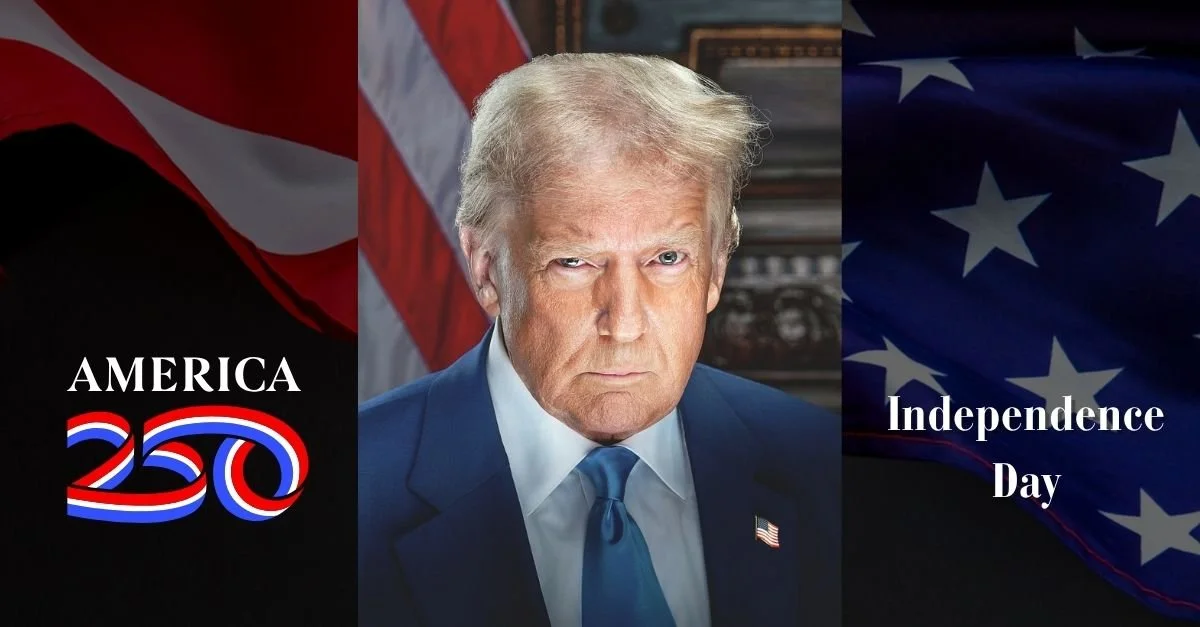
Well, that was not Donald Trump’s finest half hour.
Thirty minutes of patriotic superlatives, a freshly polished old enemy — communists — and a stage set-up that suggested someone in events may now be updating their LinkedIn profile.
Let’s begin with the entrance.
If there is one thing Trump usually understands, it is theatre. He knows the power of movement and stillness. He knows how to walk into a space, pause, hold the frame and let the audience take him in. He is, whatever one thinks of him, a performer.
But this time, the production was fighting him from the first moment.
The lighting was dreadful. Unless he was standing directly at the lectern, he appeared to be wandering in the dark like a man looking for the cheese platter at a poorly organised wedding. Then, as if the stage needed more mystery, some random man snuck out behind him. And then the planes were late.
The planes. Were. Late.
For a speech built around national grandeur, military precision and historic destiny, delayed aircraft are not ideal. It is hard to declare unmatched greatness while everyone is quietly wondering whether the flyover has been caught in traffic.
The brass band did not help. It played so slowly it sounded less like a celebration for Prince Akeem arriving in Coming to America. All that was missing was someone scattering rose petals and a deeply worried goat. Instead of lifting the tone, it gently lowered it into the ceremonial basement.
Trump began in familiar territory: audience flattery. He thanked the crowd, greeted distinguished guests and even praised the planes, which eventually arrived — late, but apparently still magnificent.
The central message was clear. America, we were told, is a “magnificent triumph”. It is the “oldest republic on earth”, made up of the “freest people on earth”, governed by the “most righteous and enduring constitution on earth”, and is the “strongest and most powerful country on earth”.
In case anyone missed the point, the United States is also the “most successful, most accomplished, most exceptional nation ever to exist in human history”.
Subtlety had not been invited.
The speech was built on contrast. America received the full golden carriage treatment. Communists were handed the broom cupboard.
America had “liberty, justice, equality, self-government and prosperity”.
Communists had “suffering, poverty, exploitation, violence and misery”.
These lists of five were actually a neat variation on the usual tricolon. But do not worry, the tricolons were there too. Trump may change enemies, jackets and legal teams, but he does not abandon a three-part rhythm.
America had “liberation, adventure and unmatched greatness”.
Communists were associated with “illegal immigrants, criminals and everybody who doesn’t want to work”, as well as being “foolish, stupid and unwise”.
America stood for “justice, principle and tradition”.
Communism delivered “mass theft, mass control and mass murder”, culminating in “death, tyranny and the pursuit of evil”.
By this point, the speech had become less an anniversary address and more a verbal fireworks display, with each sentence trying to outshine the last. The problem with so many superlatives is that they start to cancel each other out. If everything is the greatest, strongest, freest, most righteous and most exceptional, the audience eventually stops hearing meaning and starts hearing wallpaper.
From a performance perspective, the speech was heavily read. Trump shifted from side to side as he worked through the text, typically shifting after three statements.
Vocally, he used his familiar pattern: phrases ending not with a classic downward inflection, but with a static pitch that creates a sense of anticipation. It is one of his recognisable vocal habits. The sentence does not quite land; it hovers. This keeps the audience waiting for the next phrase, the next claim, the next punch.
When he wanted to close a section dramatically, he centred his body and threw his arms out in the classic Trump “behold” pose — somewhere between political saviour, opera finale and man who has just found the Lord.
The most engaging moments came when he went off script. That is when Trump usually lifts. He doused the audience with praise and created the feeling of direct connection. “Tomorrow is important,” he told them, before adding that he wanted to be “here tonight with you”.
That is Trump’s real performance strength. Not policy. Not precision. Not narrative elegance. It is the ability to make a crowd feel seen, chosen and central to the moment.
But overall, the speech was too long, too loaded and too repetitive. It had the ingredients of Trumpism — grandeur, grievance, enemies, praise, patriotism and theatrical gesture — but the staging let him down, the rhythm became predictable and the superlatives arrived in such volume they began to lose force.
After thirty minutes, he closed by declaring this was “only the beginning”.
To be honest, I was rather relieved it was the end.
Love,
Dr Louise Mahler