

How to stop speaking too fast without sounding sedated
One of the most common pieces of feedback given to anyone who opens their mouth under stress is:
“You speak too fast.”
It sounds helpful. It is misleading.
You go away believing there is a correct speed for human communication—somewhere around 140 or 150 words per minute—and that you have exceeded the limit.
The obvious solution is to slow down.
So you start speaking as though they are reading the shipping forecast to a mildly sedated audience.
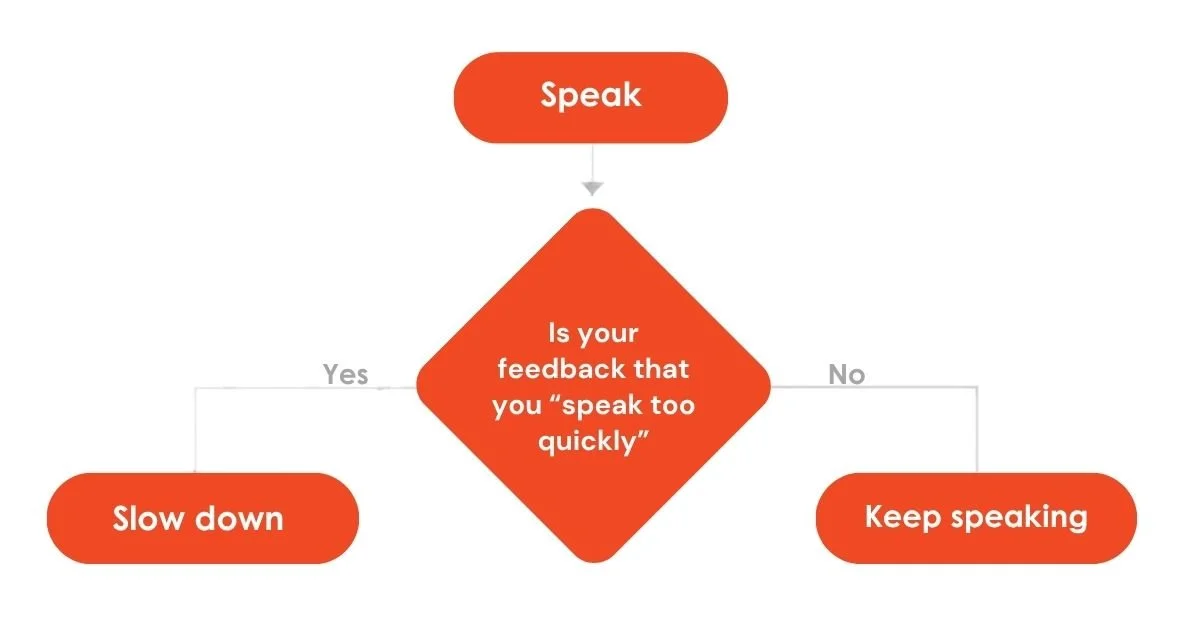
Problem solved? Not usually. It lasts for 4 seconds and then goes back to the original. Because speaking “too fast” is often not a measurement. It is a perception.
What the listener may really mean is:
“I can’t follow you.”
“I can’t find the important point.”
“You are making me feel breathless.”
Or, less generously:
“You are irritating me.”
That is a different problem entirely.
Speed is not the enemy
Some highly successful speakers talk at a ferocious pace.
Tony Robbins can deliver information like a verbal machine gun. Gary Vaynerchuk speaks with relentless energy and urgency. Barack Obama, by contrast, is known for a more measured delivery but even he changes pace, accelerating through some sections and slowing dramatically through others.
There is no single correct speed.
Speaking is not a metronome. It is a musical composition.
A march has one pace. A waltz has another. A Mozart aria can race, float, stop and soar, sometimes within a few bars. Who are you?
The problem is not necessarily that you are speaking quickly. The problem is that your listener cannot hear the composition.
The solution is not to “pause”
You may have been told to pause more often.
I dislike the word pause.
For many speakers, pausing means freezing unnaturally while silently counting to three. They stop moving, stare desperately and look static.
It can feel less like communication and more like a hostage negotiation.
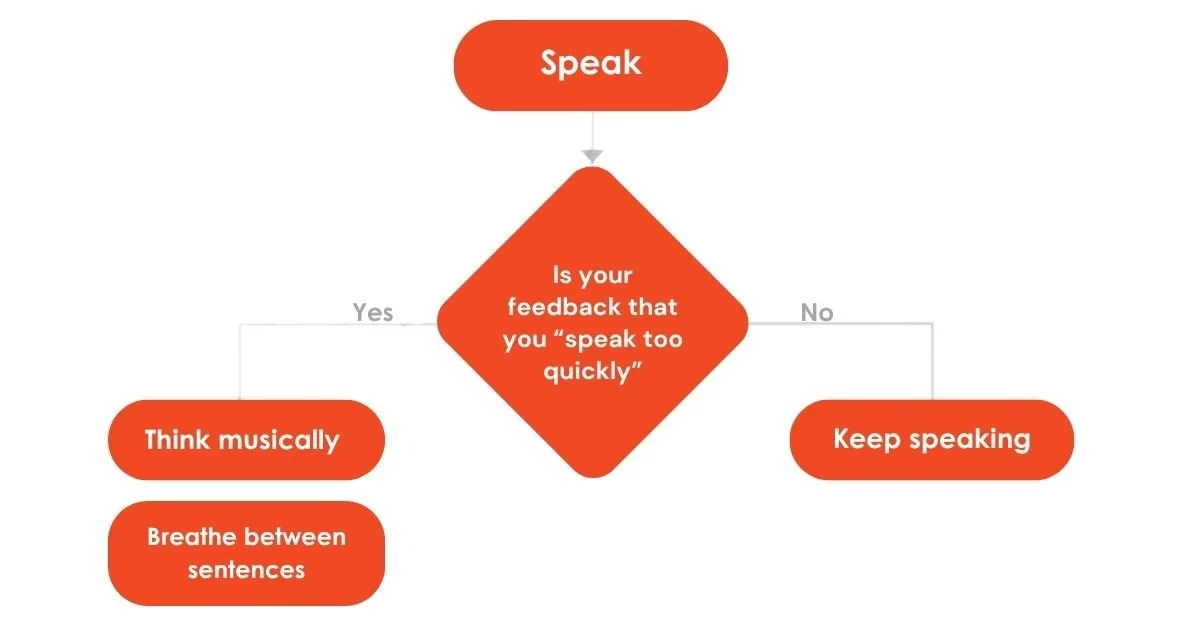
Instead, breathe and gesture.
Breathing is not an artificial performance technique. It is movement. Air leaves the body, returns to the body and creates a natural gap between ideas.
That gap gives your listener time to process what you have said.
Why do people think you are speaking too quickly?
There are two common possibilities.
1. It is your natural style
You may simply be a fast, energetic speaker. That pace could be part of your personality and one of the qualities that makes you who you are.
You do not necessarily need to remove it.
You do, however, need to create space between your ideas.
Keep the energy within the sentence, then breathe before beginning the next one.
Think of music. The piccolo may play rapidly, but it does not play continuously from the beginning of the symphony to the end. Eventually, even the piccolo has the good sense to stop.
2. You are stressed
When people are nervous, they often take small breaths high in the chest. The body tightens, the breath becomes shallow and the words tumble out in a desperate rush.
There is no space between sentences because there is barely enough air to finish them.
In this case, the issue is not your speaking speed. It is your breathing pattern.
Your diaphragm may be gripping. A gentle cough can help release that tension. Then allow the breath to drop lower into the body before you speak again.
You are not trying to become slow. You are trying to become audible, understandable and listenable.
Three ways to make fast speech easier to follow
1. Gesture
Be the conductor of your own speech.
A revolutionary idea? No. The Ancient Greeks and Romans used breath and gesture to conduct their words. It’s not new, pussycat.
Feel the rhythm of the composition before you begin. Use your gestures to conduct and keep pace.
2. Use a framework
A structure keeps you on the rails.
Use groups of three:
Make three clear statements.
Support each with three points.
Tell people what you are going to tell them, tell them, and then tell them what you told them.
It may be an old formula, but so is the wheel, and we have not improved much upon that either.
3. Slow only the final words
You do not need to drag every sentence through treacle.
Maintain your natural energy, then slow the final three words of an important sentence.
This signals completion. It tells your listeners where the idea lands and gives your message weight.
The change in rhythm matters more than the overall speed.
The real question
When someone tells you that you speak too fast, do not immediately assume you need to slow every word.
Think more deeply.
Are you breathing? Are your ideas clearly separated? Does people know which point matters? Are you using a structure, or simply releasing your entire internal monologue into the room?
The perception may be speed. The real issue is usually clarity, breath and rhythm.
Your goal is not to sound like somebody else. It is to create a composition that people can follow - musical, understandable and unmistakably your own.
Let me hear your thoughts.
Love,
Dr Louise Mahler